


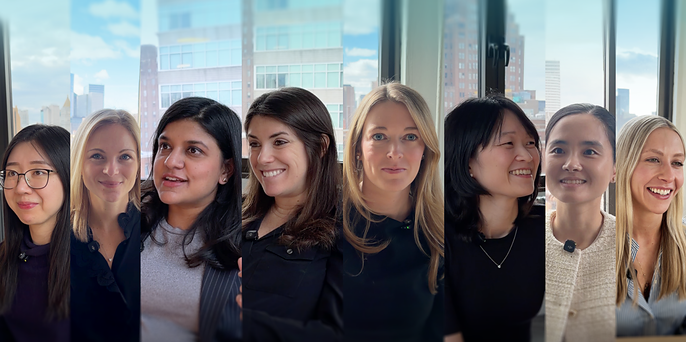
This isn’t the start of a bad joke. It’s just another day at Two Sigma.
When you think of the types of people who work in quant finance, you may think of someone who loved math as a child and has never wondered what their “passion” is because the answer has always been “calculus.”
While we certainly have plenty of folks who fit that description, meet Emily. She majored in Spanish.
And Caitlin, who studied art history and sociology, fully intended to become a museum lawyer, and now negotiates multi-billion dollar agreements.
And Ingrid, who has a master’s in aerospace engineering, worked at NASA, and currently builds AI models that predict stock movements in minutes. When we asked how she ended up here, she laughed and said: “It’s a pretty long story.”
It is. And that’s the point.
The Linear Path is a Myth
Many of us grew up hearing a similar story: pick the right major, land the right internship, follow a specific sequence of steps, and you’ll arrive at success like a train pulling into a station.
Candice was a wet-lab neuroscientist who didn’t even know how to code when she started her PhD. Her advisor told her to learn, so she took one class and then another before joining a startup analyzing credit card data for hedge funds. Today she leads healthcare research and spends her days telling stories with data.
Ingrid was supposed to get a PhD in astrophysics at Harvard.
“I chickened out at the last minute and decided to study aerospace engineering at MIT. And that definitely turned out to be a mistake,” she said. “I learned that I really don’t like engineering. It’s just not for me. I love physics, I love math, I like doing research.”
Instead, she studied aerospace engineering at MIT, and ended up working at NASA. After a while, the itch to live in New York grew, so she taught herself to code, and took a software engineering job at JP Morgan to get a foot in the door. Eventually she joined Two Sigma—still in engineering—with every intention of finding her way to research. Five years ago, she finally did.
“In a lot of ways,” she said, “it’s really the place I was always meant to be. It just took me a long time to get here.”
What Actually Transfers
Here’s the thing nobody tells you when you’re panicking about whether your major is “practical enough”: the specific knowledge matters less than you think. What matters is whether you learned how to learn.
Candice credits her PhD not for any particular neuroscience expertise, but for “learning the research process and how to think in a hypothesis-driven way.” It also taught her how to take big problems and break them down into smaller tasks that she could actually study.
This is exactly what quantitative research is. Worm neurons and stock returns have more in common than you’d expect.
Caitlin found that learning about what Two Sigma actually does (beyond her own legal work) changed how she approached her job. “The whole quant side of things is extremely new to me,” she said. “But as I’ve learned more about it, it’s made me better at what I do day to day.”
Emily, who double-majored in computer science and Spanish, puts it simply: “Everything I loved about learning a new language also played to my logical side, my analytical side.” She doesn’t use Spanish every day at work, but picking up new programming languages, she says, is just as rewarding and fun.
The Real Job Requirements
So if you don’t need the “right” degree, what do you actually need to succeed at Two Sigma? Our eight interview subjects all agreed on the following:
Curiosity. Doris, a quant researcher: “You’ve got to have genuine intellectual curiosity—not only in what you do day to day, but in what other people do, and what the business does.”
Comfort with ambiguity. Ingrid: “The kind of person who thrives here is someone who is comfortable defining their own problems to work on. No one’s going to come around and tell you ‘here’s the problem, just do a really good job.’ You have to be proactive.”
Flexibility. Aditi, an engineering manager who’s been here eleven years: “People who are quite opinionated, but remain flexible—updating their priors when new information comes in.”
Opportunities Disguised as Detours
To go from planning a career in art law to negotiating offshore fund structures as Caitlin did is quite a career pivot. She encourages other young women coming after her to be just as brave.
“Don’t be afraid to change your path. You only have one life. You should make the decisions that make you happy and find the things you’re interested in.”
Doris has been on three different teams in seven years at Two Sigma. “My career path is not typical here,” she said. “I had a lot of unexpected turns, and those turns could be a little bit scary. But thinking back, I learned a lot in all my roles. It all turns out to be useful.”
Aditi was hired as a software engineer. Two Sigma paid for her second master’s degree. She transitioned to machine learning, then to engineering management. “A very intentional journey,” she called it—but certainly not a linear one.
The Takeaway
The eight women we interviewed hold degrees in astrophysics, neuroscience, Spanish linguistics, aerospace engineering, art history, sociology, statistics, and physics. They run AI research, lead legal strategy, manage engineering teams, and build the models behind a multi billion dollar firm.
None of them followed the expected path, yet all of them belong exactly where they are. If you’ve been counting yourself out because your background doesn’t look “right” — maybe reconsider.
Interested in hearing more from these women? Hear from them directly on Two Sigma’s YouTube channel.