



Our New Seekers Summit is an annual one-day virtual program designed for first- and second-year undergraduates interested in careers in quantitative research and data science. The program gives early-career STEM students an inside look at how Two Sigma applies the scientific method to global financial markets. No finance background is required; all that’s needed is intellectual curiosity and a strong foundation in a quantitative field like computer science, mathematics, statistics, or physics.
For many attendees, the summit is their first real window into what quantitative researchers actually do, and for some students like Abe Ejilemele, it also turns into a career kickoff moment. After attending New Seekers Summit as an undergraduate at MIT, Abe has interviewed, interned, and now joined Two Sigma full-time.
We recently caught up with Abe to learn more about his journey from summit to full-time quantitative researcher and to see what advice he has for students considering applying for the summit in the future.
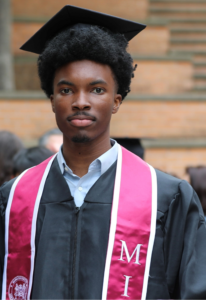
Leading up to the event
Can you tell us a little about your academic background and what initially drew you to the intersection of computer science and finance?
I’ve been interested in STEM since high school and wanted to pursue robotics in college. Upon arriving at college, I took both software/algorithmic focused computer science classes as well as classes that intersected software and hardware. I found that I resonated more with the software and algorithmic side of computer science than with the hardware side and decided to tailor my future coursework to machine learning and algorithmic courses, which I thoroughly enjoyed.
Quantitative research seemed like a good opportunity to apply the things I enjoyed learning during college to real world problems with immediate feedback on the quality of your research.
How did you first hear about Two Sigma’s New Seekers Summit, and what made you decide to apply?
I first heard about New Seekers Summit through an MIT mailing list. I had an interest in quantitative research at Two Sigma and wanted to learn more about what the role entailed. I also hoped to begin a relationship with Two Sigma and learn more about the application and interview process if I decided to apply for an internship.
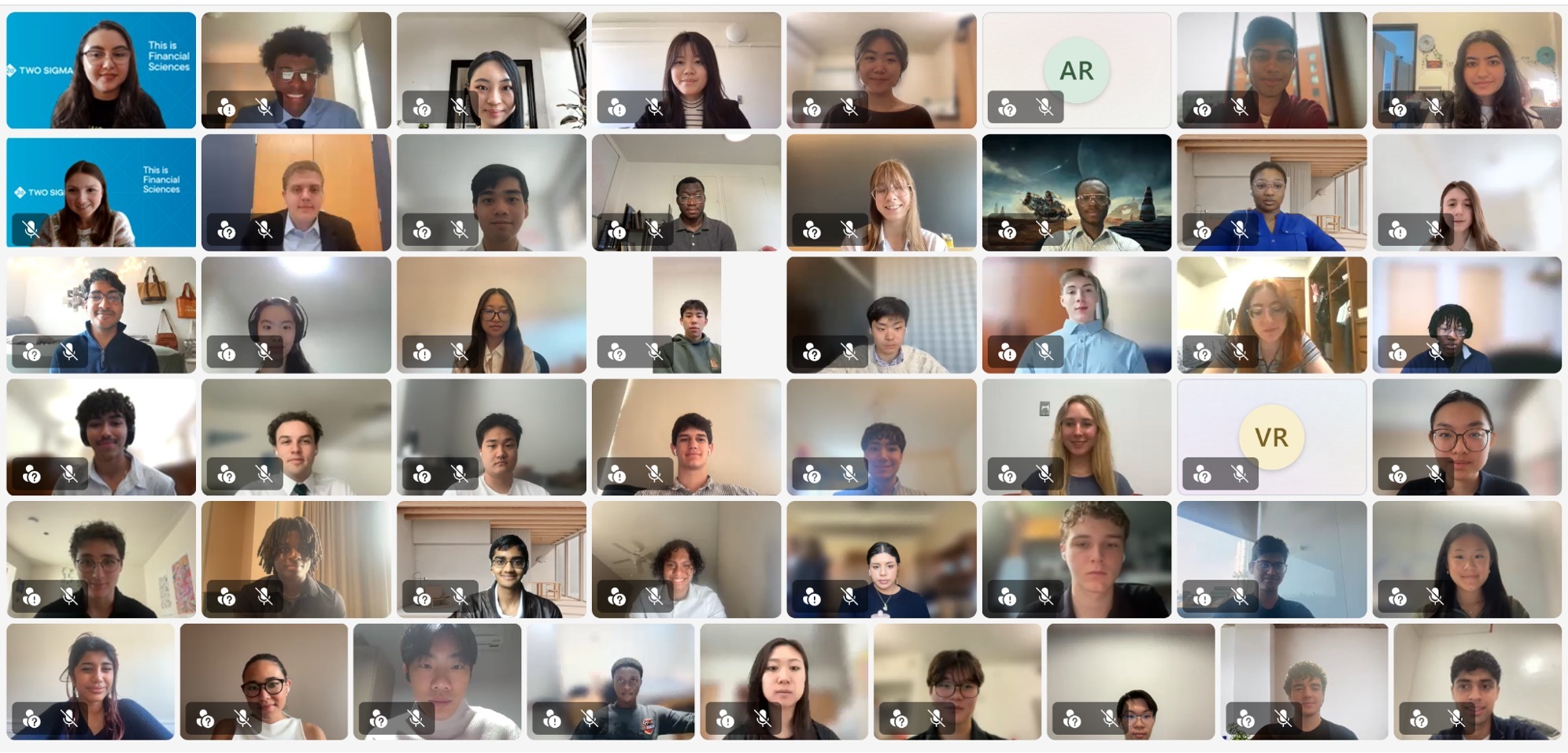
Attendees of Two Sigma’s 2026 New Seekers Summit
Reflecting on the experience
You’ve mentioned to us before that one of the most valuable parts of the summit was the chance to speak directly with Two Sigma’s researchers. What stood out to you about those conversations, and what did you learn about how they approach problems?
I really enjoyed speaking with the researchers during New Seekers Summit, and have even had the pleasure of meeting some of them when I interned and started full time. What stood out to me were their impressive backgrounds, expertise in their academic fields, as well as their lack of a finance background.
The most important thing I took away from conversations was how they approach solving research questions. Questions begin with some hypothesis about the markets. Given the hypothesis, we need to come up with a method for testing the hypothesis in a clean way. This includes thinking about what data is needed and where you could source it from, formulating the hypothesis concretely in mathematical form, and running experiments to provide evidence for or against the hypothesis. Model selection, evaluation metrics, and the training and testing setup are also paramount to doing good research. These lessons were a good starting point for the never ending journey to build good research skills.
Were there specific tools, resources, or concepts that you were introduced to during the Summit that you hadn’t encountered before?
I received multiple great recommendations that served me well in my preparations for interviews as well as during the job itself. I was introduced to Kaggle as a platform for building data science and quantitative research skills, as well as books including the Elements of Statistical Learning II that I have and still use as a learning source. I had also never encountered the practice interview problems we went through as a group. This helped me get a much better understanding of what researchers actually think about and work on.
How did attending the Summit as an undergrad shape the way you thought about your own trajectory in quantitative research?
It gave me the confidence that I would have a pathway to work at Two Sigma as a quantitative researcher even if I did not plan on getting a PhD. I was motivated to study hard for interviews and place myself in the best position possible to interview well and do well during the internship.
In what ways did the insights and perspective you gained from the summit change how you prepared for the Two Sigma interview process?
The summit gave me a good understanding of what the interview process was going to look like in terms of the types of questions asked and the considerations that one would need to be able to answer them well.
As a result, I spent time doing Kaggle competitions and reading others’ competition submissions, as well as reading blog posts about solving research type problems in addition to the typical math and statistics preparation one might do for an interview like this. This served me well not only in interviews but also in beginning to build the right intuitions and thought processes that would help me during the internship and eventually the job.
Joining Two Sigma
What was the transition from summit participant to intern like, and did the connections or knowledge from the summit give you a head start?
The transition felt quite smooth. Knowing the names and faces of a few researchers as well as coordinators of the program made it such that I was already familiar with a few people before even starting.
How does the day-to-day reality of the work as a quantitative researcher compare to what you learned about the role during the summit?
While there are numerous details and complexities that arise in day-to-day work, the general framework that we learned about is still the same. Research starts with observing some potential phenomena in existing data or reading a paper that inspires you. From there, you form a hypothesis about the observation, and do more digging into the data to strengthen your hypothesis or disprove it. Sometimes you need to collect new data to aid your exploration. After exploring the data, you come up with a concrete construction and evaluation setup to test your hypothesis. Concrete day-to-day work not covered during the summit includes implementation in code and usage of proprietary research tools and pipelines, mathematical details, evaluation details and tradeoff considerations, as well as how a potential change connects with other parts of the Two Sigma pipeline.
Offering advice for others
Looking back, is there anything you wish you had done differently during the Summit to get even more out of the experience?
I wish I had asked more questions during the event. New Seekers Summit is a great opportunity to ask as many questions as you can from people already in the industry, and it is important to take advantage of that.
For a first- or second-year undergraduate who is curious about quantitative research but isn’t sure whether they belong in the room, what would you say to encourage them to apply to New Seekers Summit?
It’s a low stress opportunity to learn more about the industry and the job, and more importantly hear from people who were also in your shoes at some point deciding what kinds of careers they wanted to pursue! It’s an invaluable opportunity to get exposed to the types of problems solved at Two Sigma as well as how researchers approach these problems. This can serve as an incredible launching point for preparing and succeeding in interviews and roles at Two Sigma.
__________________________________________________________________________________________________________________________________________________________________________________________________
Abe Ejilemele is a quantitative researcher at Two Sigma, where he joined full-time after interning on the Equities Forecast Management team in 2024. Before Two Sigma, Abe gained experience across the technology and finance industries, with internships at Microsoft, Voloridge Investment Management, Nasdaq, and Lumo Imaging. He holds a M.Eng and B.S. in Computer Science and Engineering from the Massachusetts Institute of Technology. Outside of work, Abe enjoys soccer, chess, cooking, and exploring museums.
New Seekers Summit is open once a year to first- and second-year undergraduates pursuing degrees in quantitative fields. No prior finance experience is required. Learn more about the summit at twosigma.com/new-seekers-summit.